Best PDF Parser for Better LLM and RAG
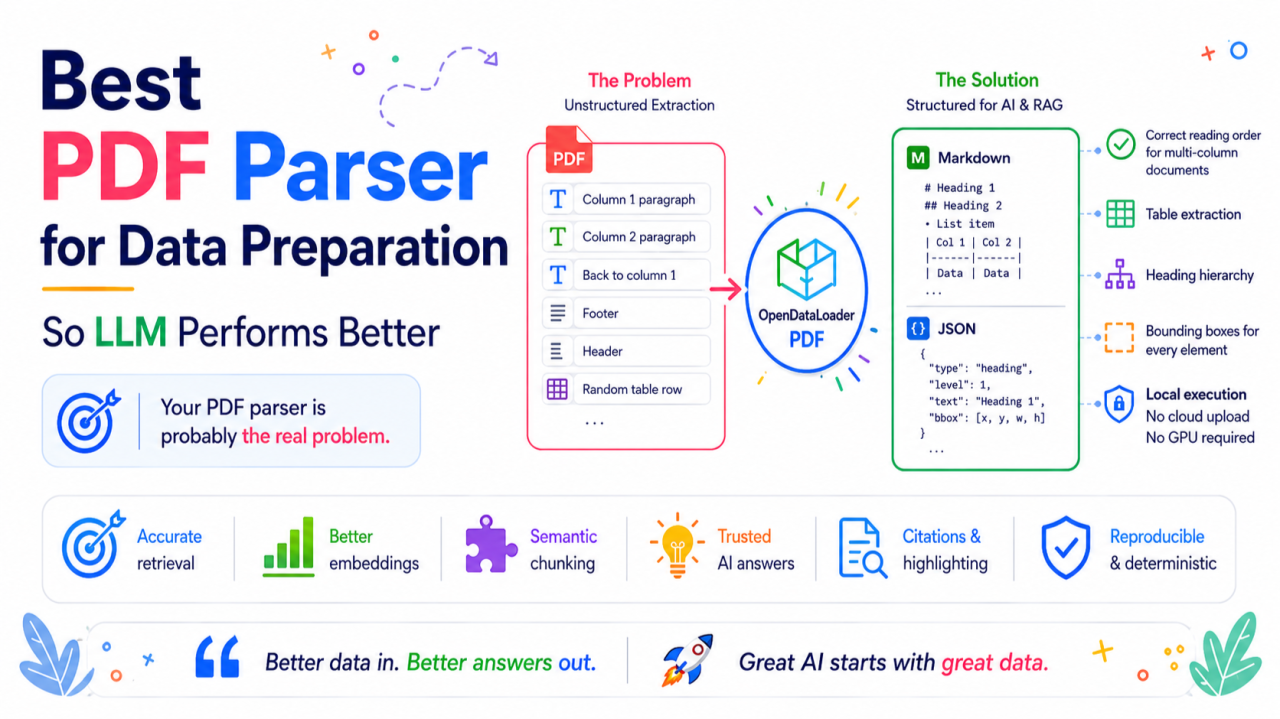
Your PDF parser is probably the real problem.
Every week I see discussions around:
- Which embedding model should I use?
- Which vector database is the fastest?
- Should I use rerankers?
- Is GPT-5 better than Claude?
- How large should my chunks be?
But very few people ask a much more important question:
Did my LLM even receive the correct document?
PDFs were never designed for AI
A PDF is made for humans to read.
Not for machines to understand.
When a typical PDF parser extracts text, it often produces something like this:
Column 1 paragraph

Column 2 paragraph

Back to column 1

Footer

Header

Random table row
To us, the original PDF looks perfectly fine.
To an LLM, it’s complete chaos.
If your extraction step is poor, every stage after that becomes harder:
- Chunking becomes inaccurate.
- Embeddings represent incorrect context.
- Retrieval misses relevant information.
- The LLM confidently generates incorrect answers.
This isn’t a prompting problem.
It’s a data problem.
That’s where OpenDataLoader PDF becomes interesting
OpenDataLoader PDF isn’t trying to be “another PDF parser.”
It’s designed specifically for AI and RAG pipelines.
Instead of extracting plain text, it preserves document structure.
Some capabilities that stood out to me:
✅ Correct reading order for multi-column documents
✅ Structured Markdown output
✅ JSON with semantic document elements
✅ Table extraction
✅ Heading hierarchy
✅ Bounding boxes for every extracted element
✅ Local execution (no cloud upload)
✅ No GPU requirement
For anyone building enterprise AI applications, these details matter much more than they appear. (OpenDataLoader PDF)
Why this matters for LLM applications
Imagine building a chatbot over 20,000 internal company PDFs.
Without proper parsing:
PDF

↓

Broken text

↓

Bad chunks

↓

Poor embeddings

↓

Wrong retrieval

↓

Hallucinated answers
With structured parsing:
PDF

↓

Structured Markdown + JSON

↓

Clean semantic chunks

↓

Better embeddings

↓

Accurate retrieval

↓

Much better answers
Many RAG failures actually originate in the very first step.
Bounding boxes are underrated
One feature I particularly like is preserving bounding boxes.
Instead of simply returning text, every extracted element knows where it came from in the original PDF.
That enables features like:
- Highlighting the exact paragraph that answered a question
- Building citation-aware chatbots
- Showing users the original page location
- Better debugging of retrieval quality
These are the kinds of features that make enterprise AI systems trustworthy.
This changes chunking strategies too
Most RAG pipelines chunk documents using fixed token counts.
For example:
- 500 tokens
- 800 tokens
- 1000 tokens
But if your parser already understands:
- headings
- lists
- tables
- captions
- paragraphs
you can chunk based on document semantics rather than arbitrary token limits.
That usually produces much cleaner retrieval.
Less AI can actually produce better AI
One thing I appreciate about OpenDataLoader PDF is that its core extraction is deterministic.
It doesn’t rely on another LLM to interpret every page.
The same input produces the same output every time.
That’s valuable for production systems where reproducibility matters.
An optional hybrid mode can enhance OCR and more complex layouts when needed, but deterministic parsing remains the foundation. (GitHub)
My takeaway
As LLM applications mature, I think we’ll spend less time chasing better prompts and more time improving data quality.
The future of RAG isn’t only about larger context windows or smarter retrieval.
It’s also about feeding models structured, high-quality information from the very beginning.
Sometimes the biggest improvement in an AI system doesn’t come from changing the model.
It comes from changing the data pipeline.
I’d love to hear what PDF parsing libraries others are using today.
Originally published on LinkedIn.