FAISS - What AI Engineer needs to know!
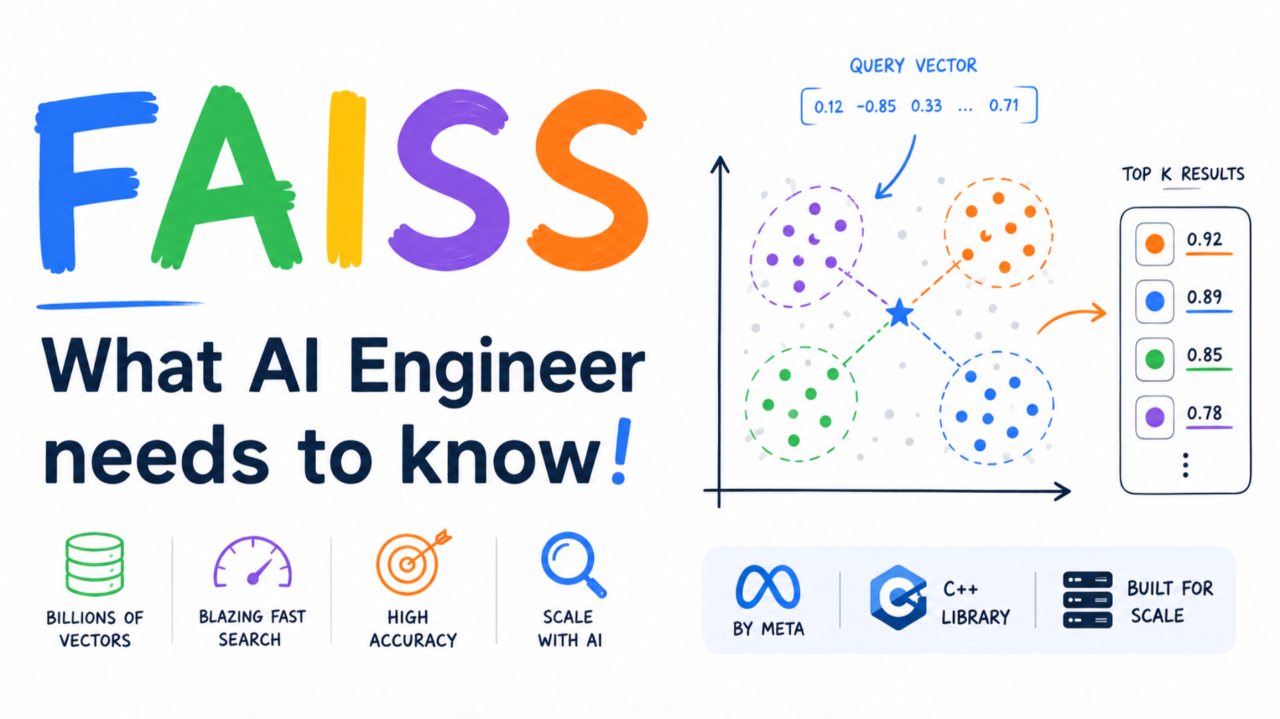
Infographic - FAISS Quick Summary
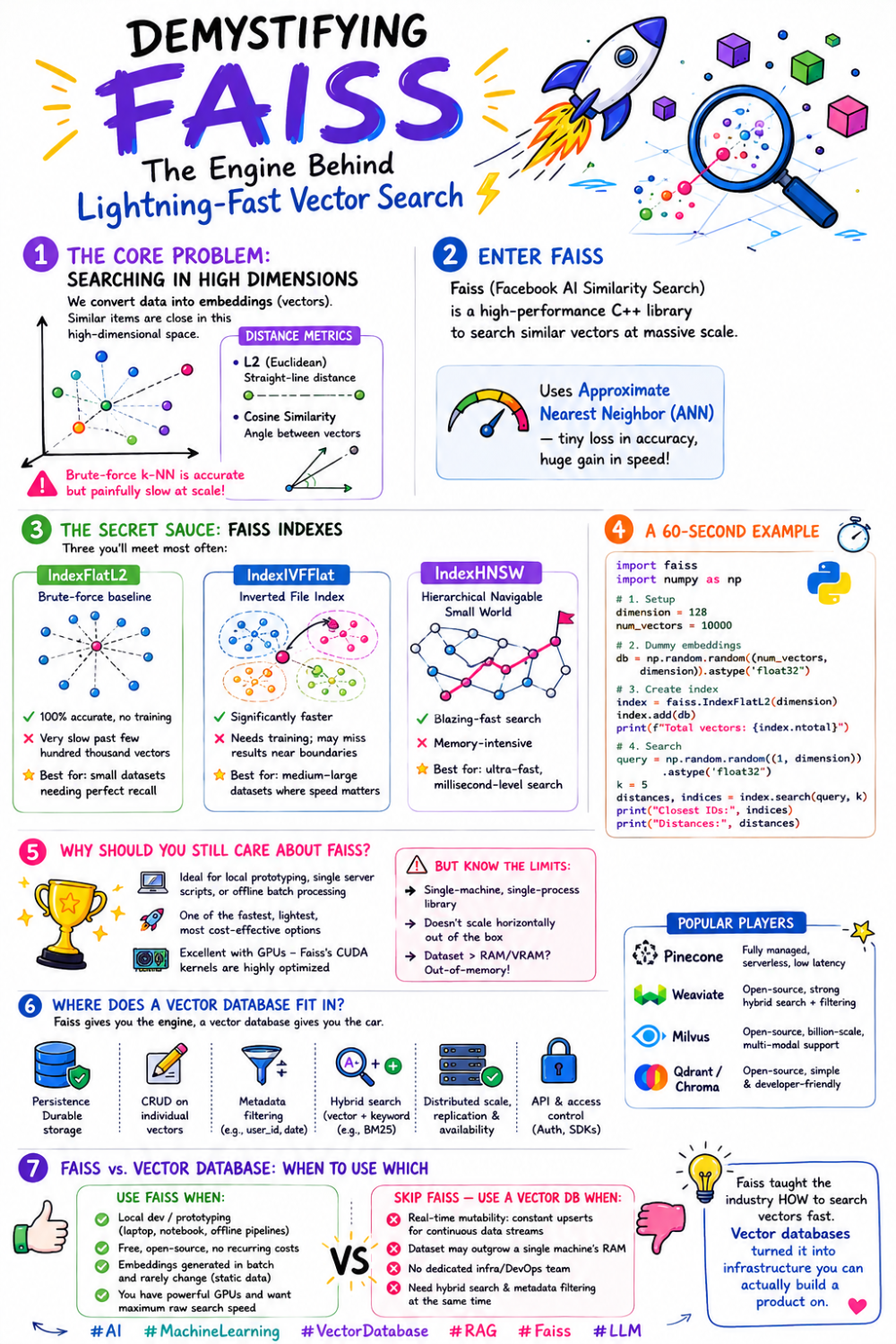
FAISS.- infographic
If you've been paying attention to the AI space recently — especially with the explosion of LLMs and Retrieval-Augmented Generation (RAG) — you've probably heard the term "vector database" thrown around.
But before we had massive, managed vector databases, we had the underlying algorithms that made searching through millions of vectors possible. At the heart of many of these systems is a library developed by Meta (formerly Facebook AI) called Faiss (Facebook AI Similarity Search).
Here's a breakdown of what Faiss is, how it solves the vector search problem, and how it connects to the vector databases everyone talks about today.
1. The Core Problem: Searching in High Dimensions
In modern machine learning, we convert unstructured data — text, images, audio — into arrays of numbers called embeddings (or vectors). If two pieces of data are conceptually similar (e.g., "I love cats" and "Felines are my favorite"), their vectors sit physically close together in a mathematical space.
To find the most similar items to a query, you measure distance using metrics like:
- L2 (Euclidean) Distance — straight-line distance between two points
- Cosine Similarity — the angle between two vectors
The bottleneck: comparing your query to every single vector in a database of 10 million items — brute-force k-Nearest Neighbors (k-NN) — is perfectly accurate but disastrously slow.
2. Enter Faiss
Faiss is an open-source library written in highly optimized C++ (with excellent Python wrappers), built to do one thing: search for similar vectors at massive scale, incredibly fast.
Instead of comparing your query to every item, Faiss uses Approximate Nearest Neighbor (ANN) search. ANN trades a tiny, often unnoticeable amount of accuracy for a massive boost in speed and memory efficiency.
3. The Secret Sauce: Faiss Indexes
The magic lies in Faiss's "Indexes." Here are the three you'll encounter most.
IndexFlatL2 — the brute-force baseline Compares your query to every vector using L2 distance. No approximation.
- Pros: 100% accurate, no training needed
- Cons: very slow past a few hundred thousand vectors
- Best for: small datasets needing perfect recall
IndexIVFFlat — Inverted File Index Groups vectors into clusters (Voronoi cells). A search first finds the right cluster, then only searches within it.
- Pros: significantly faster than Flat search
- Cons: needs a training step; may miss results near cluster boundaries
- Best for: medium-to-large datasets where speed matters and slight approximation is fine
IndexHNSW — Hierarchical Navigable Small World A graph-based approach — think highways, local roads, and dirt paths connecting your vectors. Search zooms down the highways first, then narrows in locally.
- Pros: blazing-fast search, even at massive scale
- Cons: memory-intensive (stores the graph alongside the vectors)
- Best for: ultra-fast, millisecond-level search when you have RAM to spare
4. A 60-Second Example
Despite its power, Faiss is surprisingly easy to use in Python:
import faiss
import numpy as np

# 1. Setup your parameters
dimension = 128       # size of your vectors
num_vectors = 10000    # items in your database

# 2. Generate dummy data (simulating embeddings)
database_vectors = np.random.random((num_vectors, dimension)).astype('float32')

# 3. Create the Faiss Index
index = faiss.IndexFlatL2(dimension)
index.add(database_vectors)
print(f"Total vectors in index: {index.ntotal}")

# 4. Search the Index
query_vector = np.random.random((1, dimension)).astype('float32')
k = 5
distances, indices = index.search(query_vector, k)

print("Closest vector IDs:", indices)
print("Distances:", distances)
5. Why Should You Still Care About Faiss?
With the rise of managed vector databases like Pinecone, Weaviate, or Milvus, you might wonder if raw Faiss is obsolete.
Not at all — but it does have a hard limit worth knowing upfront:
- Faiss cannot scale horizontally across servers out of the box. It's inherently a single-process, single-machine C++ library.
- If your dataset exceeds the RAM (or VRAM) capacity of one machine, standard Faiss will throw an out-of-memory error rather than spilling over to another node.
- You can make Faiss scale across multiple servers, but you'd have to build that entire distributed infrastructure — sharding, routing, replication — yourself.
That's exactly the gap managed vector databases fill: high availability, automatic scaling, and CRUD operations (updating/deleting individual vectors — something Faiss isn't great at).
But within a single machine, Faiss is still the foundational tool:
- Ideal for local prototyping, running scripts on a single robust server, or offline batch processing
- Remains one of the fastest, lightest, most cost-effective ways to work with massive vector datasets
- Especially strong if you have dedicated GPUs, since Faiss's CUDA kernels are highly optimized for raw search speed
6. So Where Does a Vector Database Fit In?
Everything above — IndexFlatL2, IndexIVFFlat, IndexHNSW — describes a search algorithm, not a product. A vector database is what you get when you wrap a full storage system around one of those algorithms. Simple way to think about it: Faiss gives you the engine, a vector database gives you the car.
A vector database adds what Faiss leaves out:
- Persistence — Faiss indexes normally live in memory; a vector DB handles durable storage
- CRUD on individual vectors — updating or deleting one vector after the fact is clunky in Faiss; vector DBs make it a first-class operation
- Metadata filtering — search vectors AND filter by fields like date, user ID, or category, in one query
- Hybrid search — combining dense vector similarity with traditional keyword search (like BM25)
- Distributed scale, replication, and availability — sharding across nodes and keeping data available as your collection grows
- An API and access control — a client library or REST/gRPC API with authentication, instead of a hand-rolled service around a raw index
A few well-known players:
- Pinecone — fully managed, serverless, popular for production RAG apps needing low latency and minimal ops
- Weaviate — open-source, known for strong native hybrid search (keyword + vector) plus rich filtering
- Milvus — open-source, built for billion-scale collections with multiple index types and multi-modal support
- Qdrant / Chroma — open-source, often favored for simpler developer experience in smaller or mid-sized projects
One nuance worth getting right: it's not accurate to say all vector databases run Faiss under the hood. Milvus is the clearest real connection — its indexing layer has historically integrated Faiss as one of several pluggable index backends (alongside libraries like HNSWlib and DiskANN), though at very large scale some teams have since migrated away from it, citing the operational overhead of managing huge numbers of Faiss index files. Weaviate, Qdrant, and Chroma, by contrast, use their own custom-built indexes (typically HNSW-based) rather than the Faiss library itself, and Pinecone's engine is proprietary and undocumented.
What Faiss did do, universally, is pioneer the ANN algorithms — IVF-style clustering, HNSW-style graph search — that the rest of the field then reimplemented and built production infrastructure around. So learning Faiss means learning the core ideas nearly every vector database is built on, even in the many cases where the actual code isn't Faiss's.
7. Faiss vs. a Vector Database: When to Use Which
Use Faiss when:
- You're doing local development or prototyping — experiments on a laptop, in a notebook, or an offline data science pipeline
- You want a completely free, open-source option and want to avoid recurring cloud database costs
- Your embeddings are generated once in a batch and rarely or never change (a largely static dataset)
- You have dedicated, powerful GPUs and want to exploit Faiss's highly optimized CUDA kernels for maximum raw search speed
Skip Faiss — use a managed vector database — when:
- You need real-time data mutability: constant, immediate upserts (inserting and updating vectors dynamically) for continuous data streams
- Your dataset is likely to outgrow a single machine's RAM, since Faiss doesn't natively handle sharding, replication, or distributed clustering
- You don't have a dedicated infra/DevOps team, since Faiss leaves index building, memory management, snapshots, and API hosting entirely up to you
- You need hybrid search — filtering results by metadata like user_id or date at the same time as the vector search, which Faiss isn't optimized for
In short: Faiss taught the industry how to search vectors fast. Vector databases took that idea and turned it into infrastructure you can actually build a product on.
#AI #MachineLearning #VectorDatabase #RAG #Faiss #LLM
Originally published on LinkedIn.