Tabular Foundation Models Explained: The Missing Piece I Didn't Know Existed
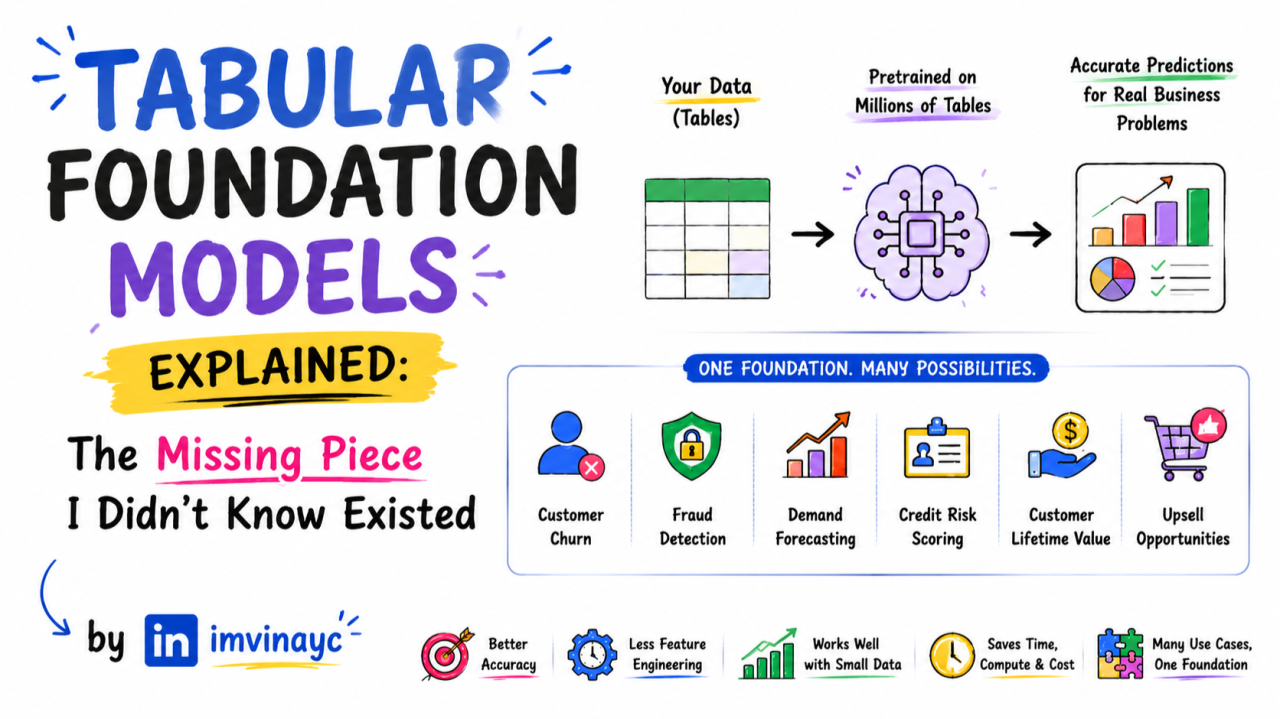
Tabular Foundation Models - Infographic
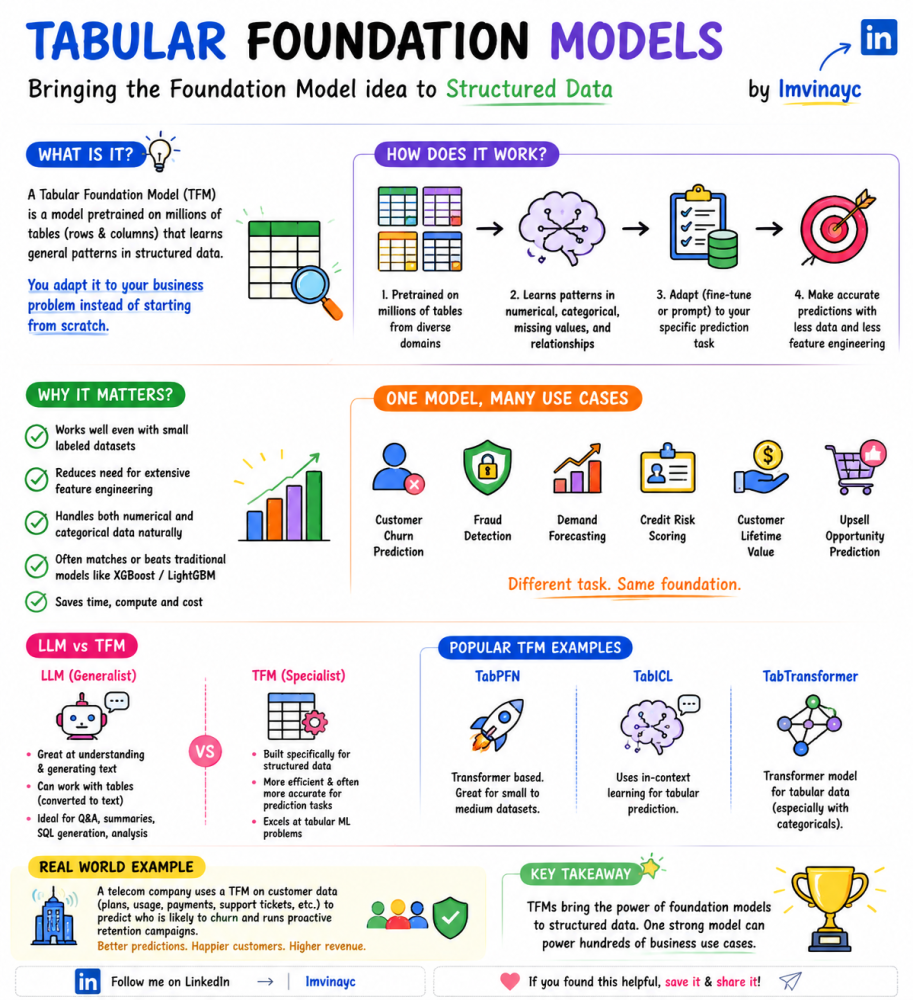
Tablular Foundation Models Explained - infographic - by Vinay C
Over the last few days, I spent some time reading about Tabular Foundation Models (TFMs). At first, I assumed they were just another machine learning model. The more I read, the more I realized they're trying to bring the "foundation model" idea that worked so well for text into the world of structured data.
If you've worked with enterprise applications, you've probably seen tabular data everywhere—customer records, transactions, orders, invoices, claims, support tickets, inventory, employee records... the list never ends.
This is exactly the kind of data TFMs are built for.
What is a Tabular Foundation Model?
The idea is surprisingly simple.
Instead of training a brand-new model every time you want to predict customer churn, detect fraud, forecast demand, or estimate customer lifetime value, you start with a model that has already learned patterns from a large collection of tabular datasets.
You then adapt that model to your business problem instead of building everything from scratch.
Very similar to how we use LLMs today.
One question I had...
My first thought was:
"Will we end up with thousands of TFMs? One for churn, another for fraud, another for forecasting?"
Turns out, that's probably not the direction.
The goal is to have a general-purpose tabular foundation model that can be adapted to many prediction tasks.
Think of it this way:
- One LLM can write emails, summarize documents, answer questions, and generate code.
- Likewise, one TFM could support churn prediction, fraud detection, demand forecasting, credit scoring, and many other tabular prediction tasks.
The task changes. The foundation model largely stays the same.
Then another question came to mind...
If modern LLMs can already understand tables, why do we even need TFMs?
From what I learned, it comes down to specialization.
LLMs are generalists.
TFMs are built specifically for structured data. They tend to be more efficient and can achieve better performance on many tabular prediction problems.
Today, both approaches have their place.
- Need a conversational assistant that can answer questions about business data? An LLM is a great fit.
- Need highly accurate predictions from structured datasets? A TFM (or even traditional models like XGBoost) may still be the better choice.
My biggest takeaway
The interesting part isn't just another model architecture.
It's that the foundation model idea is expanding beyond text.
We're seeing specialized foundation models emerge for code, images, biology, robotics, and now structured enterprise data.
I'm curious to see whether dedicated TFMs remain a category of their own, or whether future LLMs become good enough that they absorb this capability as well.
Either way, it's an exciting space to watch.
Have you explored Tabular Foundation Models yet? I'd love to hear your thoughts or any good resources you've found.
Originally published on LinkedIn.