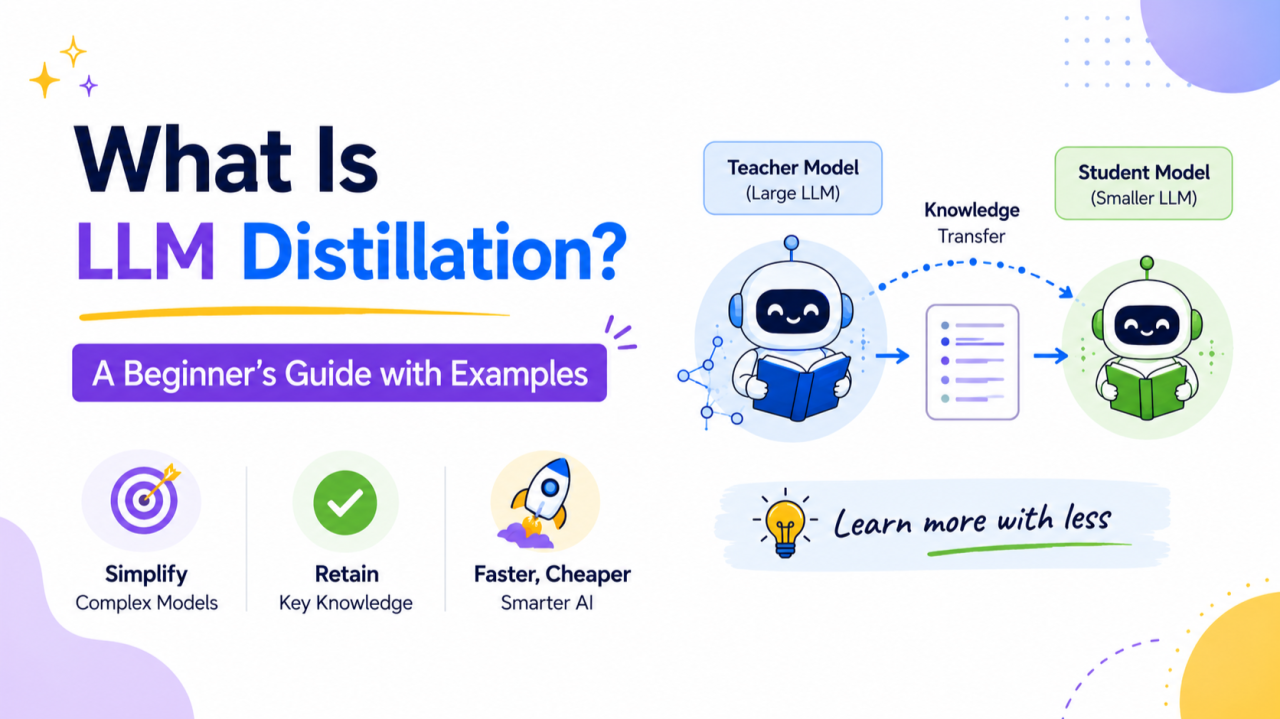
What Is LLM Distillation? A Beginner’s Guide with Examples
Quick Infographic
In case you are short on time, check out this infographic for quick summary.
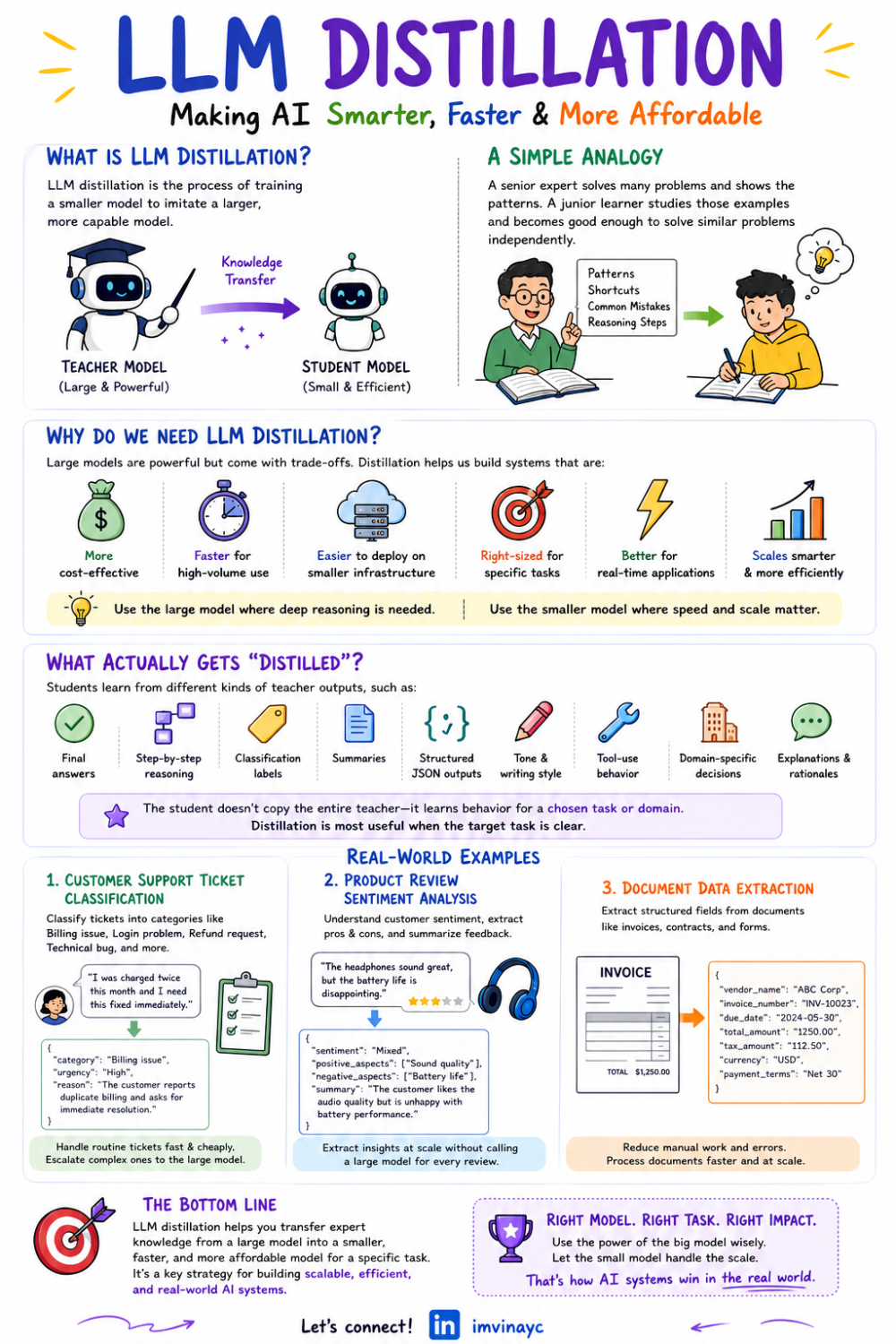
infographic - imvinayc on What Is LLM Distillation? A Beginner’s Guide with Examples
Most conversations about AI start with one question:
“Which is the most powerful model?”
But in real-world AI products, the better question is often:
“Which model is right for this specific job?”
A large language model can be excellent at reasoning, summarizing, coding, writing, and handling complex instructions. But using the largest model for every request can be expensive, slower, and sometimes unnecessary.
That is where LLM distillation comes in.
LLM distillation is one of the most practical techniques for making AI systems faster, cheaper, and easier to scale while still keeping strong performance for a specific task.
Let’s break it down in simple terms.
What Is LLM Distillation?
LLM distillation is the process of training a smaller model to imitate a larger, more capable model.
The larger model is usually called the teacher model.
The smaller model is called the student model.
The teacher already knows how to perform a task well. The goal is to transfer part of that knowledge to the student, so the student can perform the same task with lower cost, lower latency, and fewer compute requirements.
Think of it like this:
A senior expert solves hundreds or thousands of examples. A junior learner studies those examples. Over time, the junior learner becomes good enough to handle many similar cases independently.
The junior learner may not know everything the senior expert knows, but for a narrow, well-defined task, they can become very effective.
That is the core idea behind distillation.
A Simple Analogy
Imagine a math teacher helping a student prepare for an exam.
The teacher does not just give the final answer. A good teacher also shows patterns, shortcuts, common mistakes, and reasoning steps.
After practicing enough examples, the student starts solving similar problems without needing the teacher every time.
LLM distillation works in a similar way.
A large model produces high-quality outputs for many examples. A smaller model is then trained on those outputs. The smaller model learns the patterns and becomes useful for that specific type of work.
Why Do We Need LLM Distillation?
Large models are powerful, but they come with trade-offs.
They can be:
- More expensive to run
- Slower for high-volume use cases
- Harder to deploy on smaller infrastructure
- Overkill for repetitive tasks
- Less practical for real-time applications
For example, imagine a company receives 1 million customer support tickets every month.
Using a large model to read, classify, summarize, and route every single ticket might work, but it could become costly. A distilled smaller model could handle the common cases quickly and cheaply, while the larger model is reserved for more complex cases.
This creates a smarter system:
Use the large model where deep reasoning is needed. Use the smaller model where speed and scale matter.
What Actually Gets “Distilled”?
In traditional machine learning, knowledge distillation often means training a smaller model on the prediction patterns of a larger model. Geoffrey Hinton, Oriol Vinyals, and Jeff Dean helped popularize this idea in their 2015 work on distilling knowledge from larger models into smaller ones.
With LLMs, distillation can involve learning from different kinds of teacher outputs, such as:
- Final answers
- Step-by-step reasoning patterns
- Classification labels
- Summaries
- Structured JSON outputs
- Tone and writing style
- Tool-use behavior
- Domain-specific decisions
- Explanations and rationales
The student model is not magically copying the whole teacher model. Instead, it learns behavior for a chosen task or domain.
That distinction is important.
Distillation is usually most useful when the target task is clear.
Example 1: Customer Support Ticket Classification
Let’s say a business wants to classify incoming support tickets into categories:
- Billing issue
- Login problem
- Refund request
- Technical bug
- Account cancellation
- General question
A large teacher model can read historical tickets and produce high-quality labels.
Example input:
“I was charged twice this month and I need this fixed immediately.”
Teacher model output:
{
  "category": "Billing issue",
  "urgency": "High",
  "reason": "The customer reports duplicate billing and asks for immediate resolution."
}
Now imagine generating thousands of such examples using the teacher model.
Those examples can be used to train a smaller student model.
Once trained, the student model can classify new tickets quickly and cheaply.
The large model can still be used for unusual or complex tickets, but the student model can handle the routine workload.
This is a classic distillation use case: take expensive expert behavior and transfer it into a smaller model for repeated tasks.
Example 2: Product Review Sentiment Analysis
Suppose an e-commerce company wants to analyze product reviews.
A review might say:
“The headphones sound great, but the battery life is disappointing.”
A basic model might struggle because the review is mixed.
A teacher model can produce a more nuanced output:
{
  "sentiment": "Mixed",
  "positive_aspects": ["Sound quality"],
  "negative_aspects": ["Battery life"],
  "summary": "The customer likes the audio quality but is unhappy with battery performance."
}
A student model can learn from thousands of examples like this.
After distillation, the smaller model may become very good at extracting sentiment, product issues, and customer themes from reviews.
This helps teams understand product feedback at scale without calling a large model for every review.
Example 3: Document Data Extraction
Imagine a finance team that needs to extract data from invoices.
They want structured fields like:
- Vendor name
- Invoice number
- Due date
- Total amount
- Tax amount
- Currency
- Payment terms
A teacher model can read sample invoices and produce structured outputs.
Example:
{
  "vendor_name": "Acme Software Ltd.",
  "invoice_number": "INV-20491",
  "due_date": "2026-08-15",
  "total_amount": "12450.00",
  "currency": "USD",
  "payment_terms": "Net 30"
}
A smaller student model can then be trained to perform this extraction for common invoice formats.
The result is a faster, more cost-effective system for routine document processing.
How LLM Distillation Works: Step by Step
Here is a beginner-friendly view of the process.
1. Choose the Teacher Model
The teacher model is usually a larger and more capable model.
It should be strong at the target task. If the teacher produces poor outputs, the student will learn poor behavior.
Bad teacher, bad student.
2. Define the Task Clearly
Distillation works best when the task is specific.
For example:
- Classify support tickets
- Summarize sales calls
- Extract fields from contracts
- Generate product descriptions
- Convert messy notes into structured records
- Detect policy violations
- Rewrite messages in a brand voice
A vague goal like “make a smaller model that is good at everything” is much harder.
A clear goal like “classify refund-related tickets with urgency and reason” is much better.
3. Create Input Examples
You need examples that represent real usage.
These could come from:
- Historical support tickets
- Product reviews
- Internal documents
- Chat transcripts
- User questions
- Sales notes
- Logs
- Forms
- Emails
The better the input data, the better the student model can become.
4. Ask the Teacher Model to Generate Outputs
The teacher model processes the examples and creates high-quality answers.
This creates a training dataset.
For example:
Input:
“My account was locked after too many login attempts.”
Teacher output:
{
  "category": "Login problem",
  "urgency": "Medium",
  "recommended_action": "Guide the user through account recovery and password reset."
}
This input-output pair becomes training data for the student.
5. Clean and Filter the Dataset
This step is easy to underestimate.
Not every teacher output will be perfect.
Some outputs may be inconsistent, too verbose, incorrectly formatted, or wrong.
Before training the student, teams should review, filter, and improve the dataset.
Quality matters more than just volume.
A smaller set of clean examples can outperform a larger set of noisy examples.
6. Train the Student Model
The student model is trained using the teacher-generated examples.
In many modern workflows, this looks similar to fine-tuning: the smaller model is adjusted so it produces the desired responses for the task.
OpenAI describes model distillation as using outputs from more capable models to fine-tune smaller, more cost-efficient models for specific tasks.
7. Evaluate the Student Model
This is where many teams make mistakes.
You should not assume the student is good just because training finished.
You need evaluation.
Compare the student model against:
- A held-out test set
- The teacher model
- Human-reviewed answers
- Production success metrics
- Cost and latency targets
Useful questions include:
- Is the student accurate enough?
- Where does it fail?
- Is it faster?
- Is it cheaper?
- Does it follow the required format?
- Does it handle edge cases?
- When should the system fall back to the teacher model?
OpenAI’s guidance on evaluations emphasizes measuring model outputs against expected quality and behavior, which is especially important when optimizing or changing models.
Distillation vs Fine-Tuning vs Quantization
These terms often get mixed up, so here is a simple breakdown.
Distillation
Distillation trains a smaller model to imitate a larger model’s behavior for a task.
Goal: transfer useful behavior from teacher to student.
Fine-Tuning
Fine-tuning trains a model on task-specific examples.
Goal: adapt a model to a specific style, domain, or task.
Distillation often uses fine-tuning as part of the process, but the training examples usually come from a teacher model.
Quantization
Quantization compresses a model by reducing the numerical precision of its weights.
Goal: make the same model more efficient to run.
Quantization changes how the model is stored and executed. Distillation trains a different model to learn similar behavior.
Where LLM Distillation Is Useful
LLM distillation can be useful in many areas.
Customer Support
Classifying, summarizing, and routing tickets.
Sales
Summarizing call notes, extracting next steps, and updating CRM fields.
Finance
Extracting invoice data, classifying expenses, and reviewing transaction descriptions.
E-commerce
Generating product descriptions, analyzing reviews, and improving search relevance.
HR
Summarizing feedback, categorizing employee questions, and drafting standard responses.
Engineering
Classifying bug reports, summarizing logs, and generating structured issue descriptions.
Content Operations
Rewriting content in a specific brand voice, tagging articles, and generating metadata.
The best use cases are usually high-volume, repeatable, and measurable.
When Should You Use LLM Distillation?
Distillation is worth considering when:
- You have a repeated task
- You already know what good output looks like
- Large model usage is becoming expensive
- Low latency matters
- You have enough examples
- The task has clear evaluation criteria
- You want consistent formatting or behavior
- You can tolerate a smaller model for routine cases
In simple words:
Distillation makes sense when you are repeatedly asking a powerful model to do the same kind of work.
When Should You Avoid Distillation?
Distillation is not always the right answer.
You may not need it if:
- Your usage volume is low
- The task changes frequently
- The task requires broad reasoning
- The domain is highly sensitive
- You do not have evaluation data
- You cannot review the teacher’s outputs
- The cost of training and maintaining the student is higher than the savings
For many early prototypes, prompt engineering or RAG may be enough.
Distillation becomes more attractive once the use case is proven and scale becomes a real issue.
Common Mistakes Beginners Make
Mistake 1: Distilling Too Early
Do not distill before you understand the task.
First, build the workflow with a strong model. Learn what users need. Find the common patterns. Then consider distillation.
Mistake 2: Using Low-Quality Teacher Outputs
If the teacher output is messy, inconsistent, or wrong, the student will learn those flaws.
Review and clean the training data.
Mistake 3: Skipping Evaluation
A distilled model should be measured, not trusted blindly.
Always keep a test set that the model has not seen during training.
Mistake 4: Making the Task Too Broad
“Answer all customer questions” is broad.
“Classify billing-related support tickets into five categories” is specific.
Specific tasks are better candidates for distillation.
Mistake 5: Ignoring Fallbacks
The student model will not be perfect.
A good system knows when to escalate to a larger model or a human.
Originally published on LinkedIn.