10 AI Agent Design Patterns Every AI Engineer Should Know
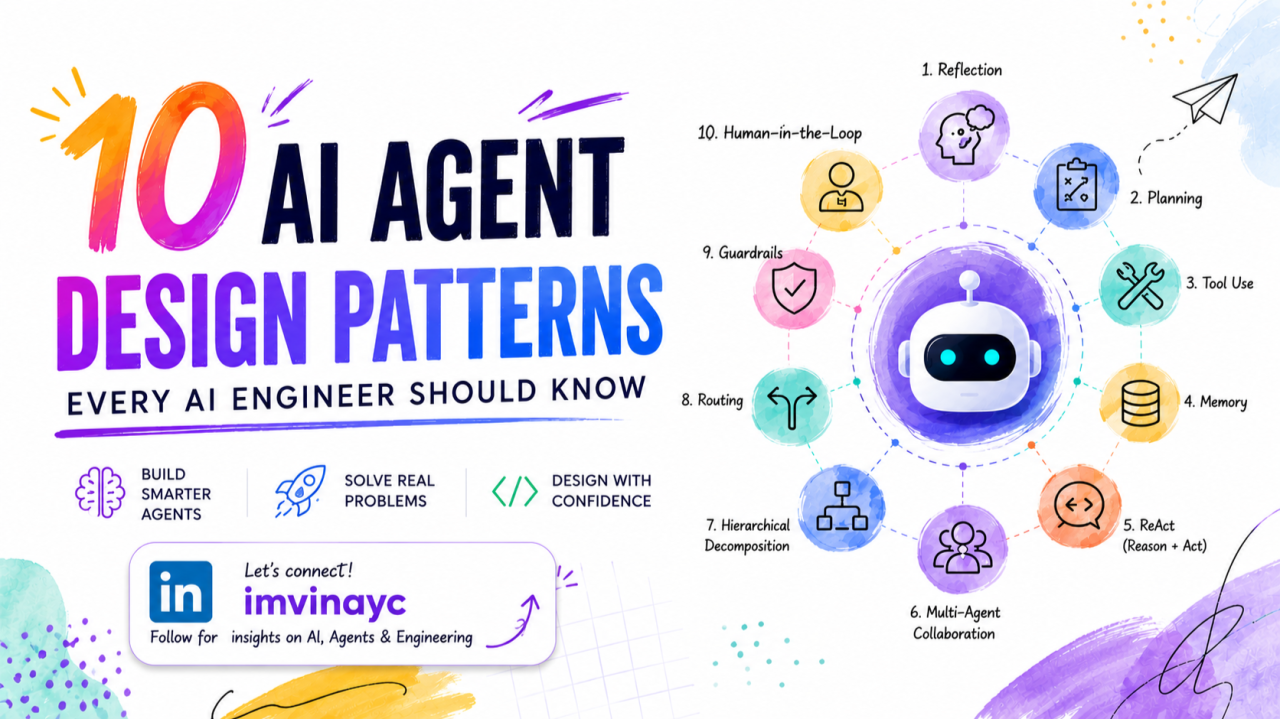
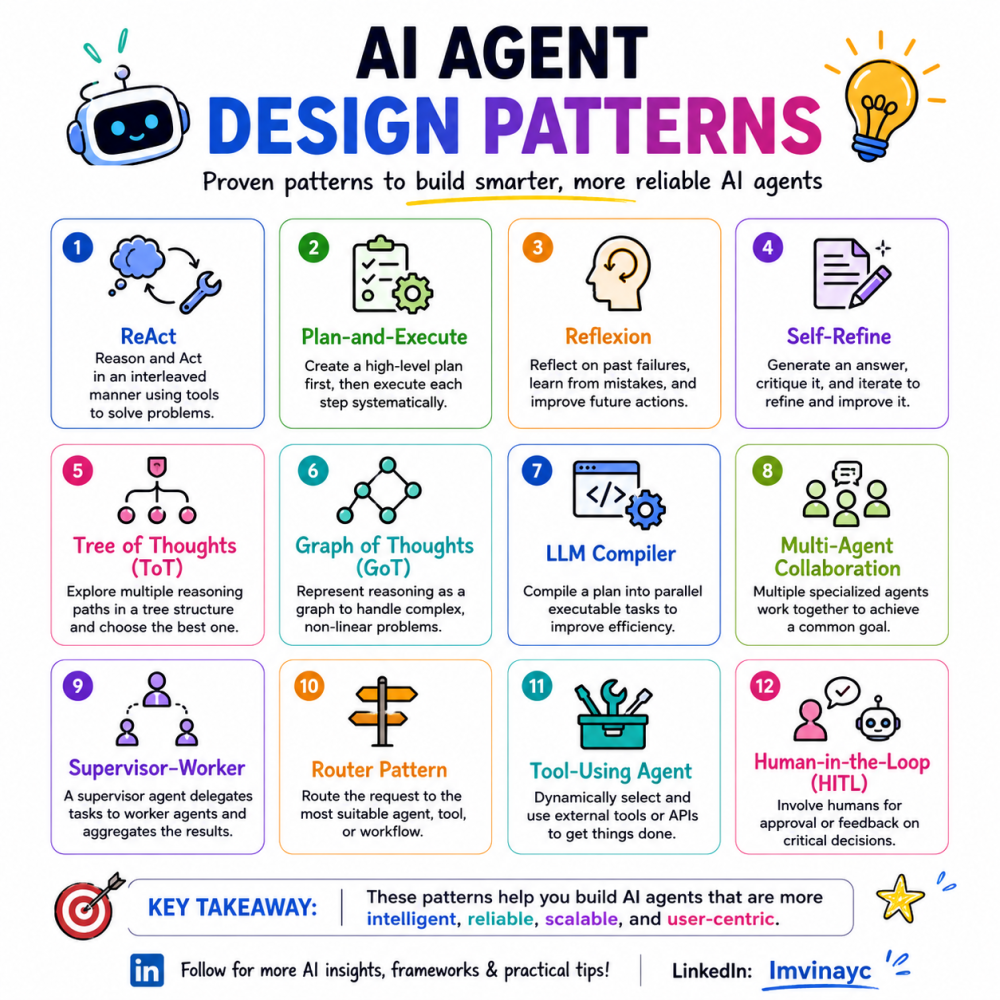
Infographic - 10 AI Agent Design Patterns Every AI Engineer Should Know
Most people learn AI agents backward.
They start with frameworks:
LangGraph. CrewAI. AutoGen. OpenAI Agents SDK.
Useful? Yes.
But here’s the problem:
Frameworks change. Patterns stay.
If you understand the design patterns behind agents, you can build systems that are easier to debug, easier to extend, and far more reliable.
The framework is just the implementation layer.
The pattern is the thinking layer.
Here’s a simple way to remember the most important AI agent design patterns:
🧠 Think → 🌳 Explore → ⚙️ Execute → 👥 Organize
That’s the lifecycle of most agentic systems.
Let’s break it down.
10 AI Agent Design Patterns You Should Know
🧠 1. ReAct
Reason + Act
The agent thinks, takes an action, observes the result, and repeats.
It does not just answer. It reasons, uses tools, checks results, and continues until it reaches a useful outcome.
Best for: Search agents, coding assistants, debugging, troubleshooting, tool-using workflows.
🧠 2. Plan-and-Execute
Instead of trying to solve everything in one shot, the agent first creates a plan.
Then it executes the plan step by step.
This makes the workflow easier to inspect, easier to control, and easier to fix when something goes wrong.
Best for: Long workflows, multi-step tasks, project automation, research workflows.
🧠 3. Reflexion
The agent reviews what happened, identifies mistakes, and improves its next attempt.
This pattern is powerful because many agent failures are not tool failures.
They are judgment failures.
Reflexion gives the agent a feedback loop.
Best for: Tasks where multiple attempts improve quality, such as coding, reasoning, research, and evaluation.
🧠 4. Self-Refine
The agent generates an output, critiques it, and improves it before showing the final version.
Think of it as an internal editor.
The first draft is not the final answer.
Best for: Writing, summarization, code generation, analysis, documentation.
🌳 5. Tree of Thoughts
Some problems do not have one obvious path.
Tree of Thoughts lets the agent explore multiple reasoning paths before choosing the best one.
Instead of going deep on one idea too early, it compares alternatives.
Best for: Complex planning, decision-making, puzzles, strategy, reasoning-heavy tasks.
🌳 6. Graph of Thoughts
Tree of Thoughts branches.
Graph of Thoughts connects.
In this pattern, ideas can split, merge, depend on each other, and influence other parts of the reasoning process.
This is useful when the problem is not linear.
Best for: Interconnected decisions, complex workflows, architecture planning, systems thinking.
⚙️ 7. LLM Compiler
The agent takes a workflow and breaks it into independent tasks that can run in parallel.
Instead of executing every step one by one, it identifies what can happen at the same time.
This reduces latency and improves efficiency.
Best for: Large workflows, parallel research, data processing, multi-tool execution.
👥 8. Multi-Agent Collaboration
Instead of one general-purpose agent doing everything, multiple specialist agents work together.
One agent may research. Another may code. Another may review. Another may summarize.
Specialization improves quality when the task is broad.
Best for: Research, software development, business workflows, product analysis.
👥 9. Supervisor–Worker
A supervisor agent breaks the work into smaller tasks, assigns them to worker agents, and combines the results.
This pattern adds structure to multi-agent systems.
The supervisor manages direction. The workers handle execution.
Best for: Large structured workflows, team-like agent systems, complex automation.
👥 10. Router Pattern
A router decides where a request should go.
Which agent should handle it? Which tool should be used? Which workflow is the right fit?
As systems grow, routing becomes essential.
Without routing, everything becomes one giant prompt.
Best for: Systems with multiple tools, multiple agents, or specialized workflows.
The easiest way to remember all 10
Don’t memorize the list.
Remember how an agent works:
🧠 Think ReAct Plan-and-Execute Reflexion Self-Refine
🌳 Explore Tree of Thoughts Graph of Thoughts
⚙️ Execute LLM Compiler
👥 Organize Multi-Agent Collaboration Supervisor–Worker Router Pattern
Once you understand the agent lifecycle, the patterns become much easier to recall.
And more importantly, they become easier to apply.
Because building good agents is not about chasing the newest framework.
It is about knowing which pattern fits the problem.
That is the difference between a demo that works once…
and an agentic system that works reliably in production.
Which of these patterns have you used in your own projects?
Follow @imvinayc for more practical content on AI engineering, system design, cloud, and software architecture.
Originally published on LinkedIn.