10 LLM application patterns you must know
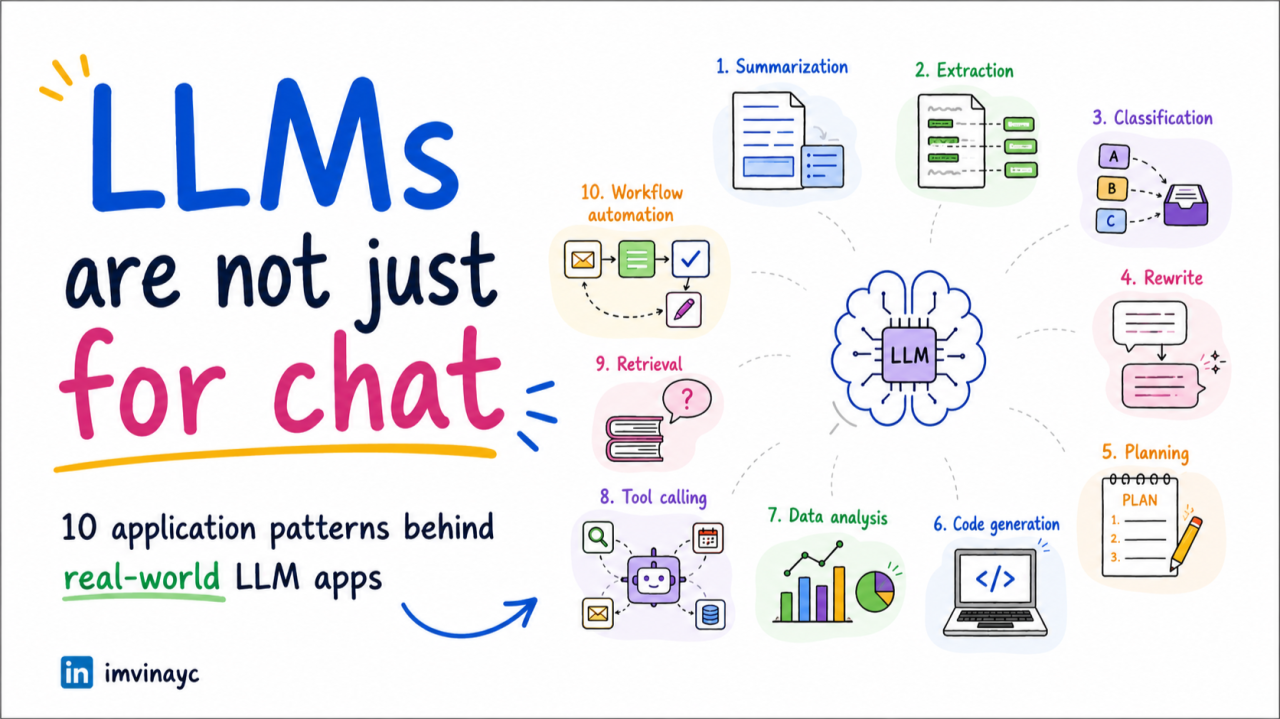
LLMs are not just for chat
When people talk about LLMs, the first thing that comes to mind is usually a chatbot.
But the chat box is only one interface.
Most useful LLM applications are built around a few repeatable patterns.
Some examples:
Summarization Turning long emails, documents, meeting notes, or support threads into something easier to understand.
Extraction Pulling useful fields from messy text, like names, dates, invoice details, customer issues, or action items.
Classification Routing tickets, tagging feedback, detecting intent, or grouping requests into the right category.
Rewrite Changing tone, simplifying language, improving clarity, or adapting content for a different audience.
Planning Breaking a goal into steps, creating task lists, drafting project plans, or helping someone think through options.
Code generation Writing boilerplate, explaining code, generating tests, or helping developers move faster.
Data analysis Looking at tables, logs, or reports and finding patterns, outliers, or useful takeaways.
Tool calling Letting the model take action through tools like search, calendar, email, databases, or internal systems.
Retrieval Answering questions using the right source of knowledge instead of guessing from memory.
Workflow automation Combining multiple steps into one flow, like reading an email, extracting details, checking a system, and drafting a response.
Quick Infographic Summary
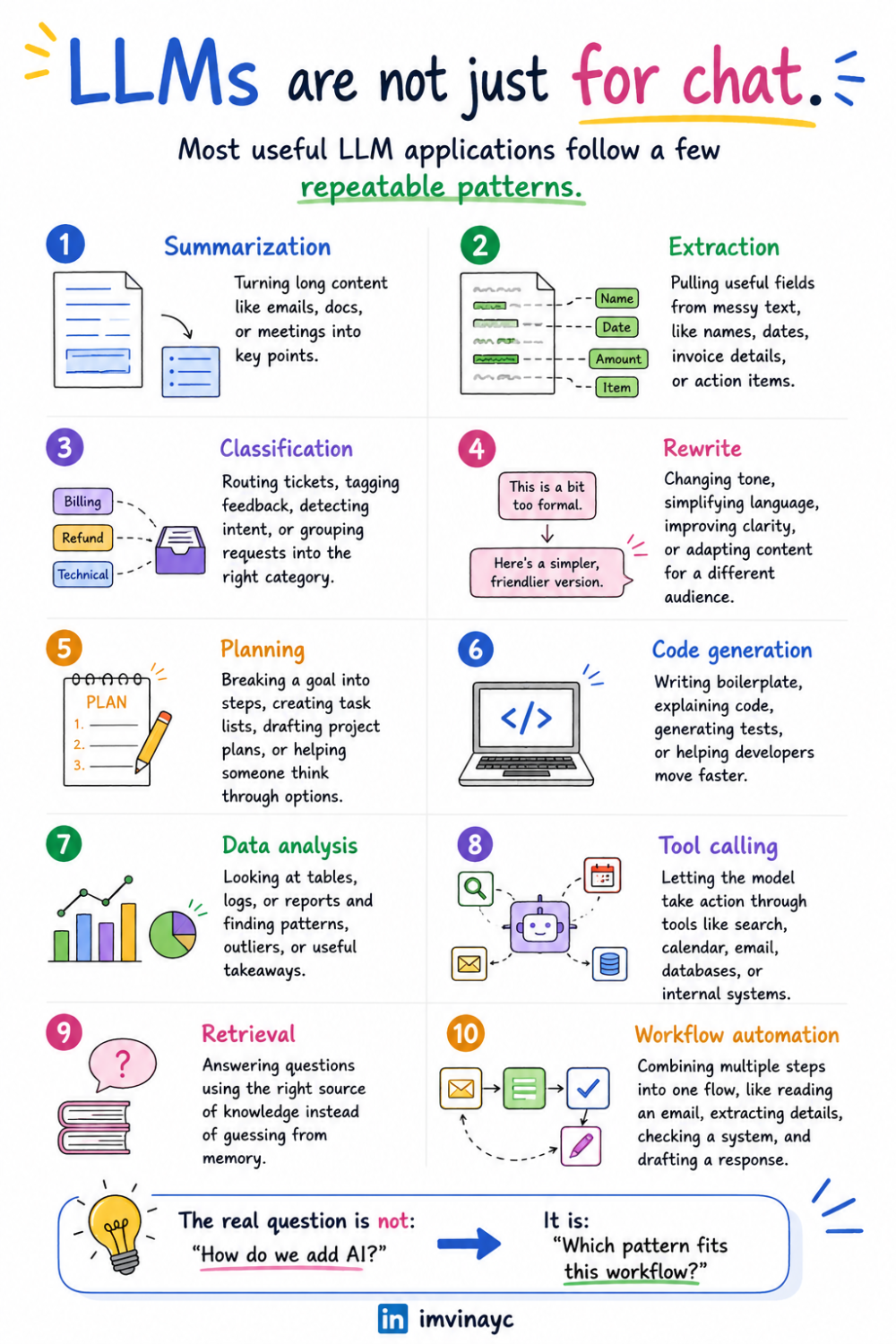
10 LLM Application Patterns - infographic by Vinay C
The more I look at LLM apps, the more I feel the real question is not:
“How do we add AI?”
It is:
“Which pattern fits this workflow?”
Once you see these patterns, it becomes much easier to spot practical use cases.
Not every problem needs a chatbot.
Sometimes it just needs summarization.
Sometimes extraction.
Sometimes classification.
And sometimes a full workflow that connects all of them.
Originally published on LinkedIn.